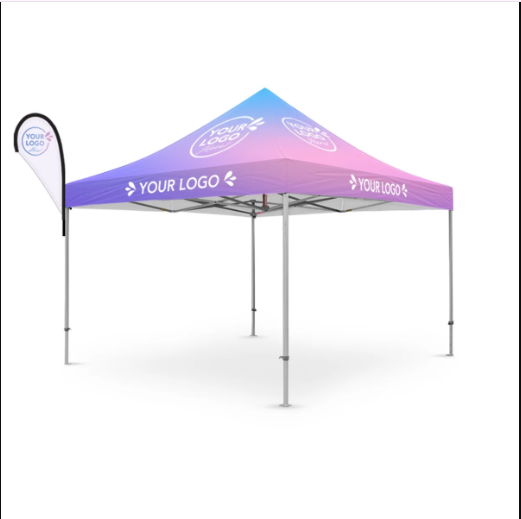
At a busy outdoor event, your brand has only a few seconds to make an impression. People are walking, talking, checking phones, and deciding which booth deserves attention. In other words, your tent is competing with the entire event.
That is why a 13×13 printed tent should be designed as more than a shelter. Done well, it becomes a portable brand environment that attracts attention from a distance, guides people into the space, and helps customers remember your company afterward.
The 13×13 size is useful because it offers more room than a standard 10×10 setup without moving into the footprint of a much larger structure. That extra space creates opportunities for stronger graphics, better traffic flow, product displays, demonstrations, and customer conversations.
The challenge is using that space intentionally. Bigger graphics are not automatically better graphics, and more logos do not automatically create more recognition. The smartest designs combine visibility, consistency, readability, and quality.
Start With the Five-Second Test
Before choosing colors, photos, or slogans, ask a simple question: what should someone understand about your booth in five seconds?
That is about how long many event attendees will give your display while walking past.
A strong 13×13 printed tent should communicate your company name, visual identity, and basic offering almost immediately. If a visitor has to study the roof to figure out what the business does, the design is asking too much.
Keep the main branding direct. Use a recognizable logo, clear company name, and brand colors with enough contrast to remain visible in outdoor light. If your company name does not explain your business, add a short descriptor on the valance rather than turning the roof into a paragraph.
Make the Roof Your Long-Range Signal
The roof is often the first part of a canopy people see, especially in a crowded event where tables and lower signage disappear behind visitors.
That makes it prime branding space.
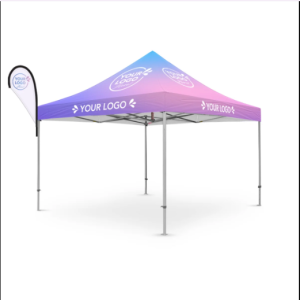
A 13×13 custom canopy can display large logos on multiple roof panels so the brand remains recognizable from different directions. This matters at festivals, fairs, races, and expos where people approach from several angles.
Avoid shrinking the logo just to make room for extra copy. Outdoor branding needs to work at a distance. Large, uncluttered graphics usually outperform designs packed with details that looked great on a computer screen but disappear in a crowded venue.
Use the roof to create recognition. Use everything below it to create interest.
Let the Valances Explain What You Do
Once customers get closer, the valance becomes valuable territory.
This is where a short tagline, product category, website, or concise benefit statement can work well. A coffee company might identify itself as a specialty roaster. A remodeling business might state the services it provides.
The key word is short.
A valance is not a billboard for your mission statement. It should reinforce the main brand message without forcing customers to slow down and squint.
A Coffee Roaster Becomes the Market Landmark
Imagine a growing coffee roaster attending farmers markets across several neighborhoods.
For months, the business uses a plain canopy with a vinyl banner across the front. Customers like the coffee, but the booth is easy to miss among rows of similar tents.
The company switches to a 13×13 printed tent using its brand colors, large roof logos, and a simple line on the valance explaining that it roasts locally.
Inside, one side handles samples while the other displays packaged coffee. A printed rear wall includes a lifestyle image and the company website.
The result is more than a visual upgrade. Repeat customers begin recognizing the canopy from across the market, first-time visitors immediately understand what the brand sells, and the extra space allows employees to serve customers without creating a bottleneck.
Use Sidewalls to Tell the Next Part of the Story
Once a visitor is close enough to see the sidewalls, you can provide more detail.
Printed walls are excellent for lifestyle photography, service categories, product imagery, before-and-after visuals, or concise brand storytelling. They also make the booth feel more finished by creating a defined visual environment.
However, do not confuse available space with an obligation to fill it.
One powerful image can communicate more effectively than five smaller images competing for attention. One short statement can be more memorable than a wall covered with text.
Think about how the wall will be viewed. Customers may stand several feet away or see it while talking with staff. Graphics should remain legible in real event conditions, not just in a design mock-up.
Create a Focal Point People Can Walk Toward
Every successful booth needs a visual destination.
That could be a new product, a demonstration table, a photo backdrop, a tasting counter, or a consultation area. Your graphics should help guide visitors toward that point.
A 13×13 printed tent provides enough room to create a clear journey. The front can remain open and inviting, the middle can feature the primary activity, and the rear can support deeper engagement.
If your strongest graphic is hidden behind inventory boxes, or your main demonstration is squeezed into a corner, the branding has lost some of its power.
A Skincare Brand Turns Sampling Into Consultation
Consider a premium skincare company attending wellness festivals.
Its goal is not simply to hand out samples. It wants customers to try products, ask questions, and understand why its formulas cost more than drugstore alternatives.
The company designs a 13×13 custom canopy with elegant roof branding, clean valance messaging, and printed walls that emphasize ingredients and product philosophy.
The front section includes testers and product displays. The rear has a small consultation counter where staff can recommend routines.
The additional room changes the experience. Customers can browse without feeling rushed, while interested visitors can move into a more detailed conversation.
The polished environment also supports premium positioning. If you are asking customers to trust a higher-priced product, the presentation should communicate care, quality, and attention to detail before the sales pitch begins.
Know When 13×13 Is Not Enough
A 13×13 footprint is versatile, but there are times when a larger rectangular format makes more sense.
If your business needs separate demonstration and consultation zones, significant inventory, several staff stations, or a longer serving counter, a 13×20 canopy may be more practical.
A 13×20 canopy tent provides additional length while keeping a manageable width. That can be useful for food service, product launches, sports activations, and larger retail displays.
The decision should be based on function. A well-designed 13×13 space can outperform a poorly planned 13×20 setup, but if staff are constantly rearranging furniture or blocking displays, moving to a larger footprint may improve both operations and customer experience.
A Home Services Company Makes an Invisible Service Visible
Now picture a remodeling company attending an outdoor home-and-garden event.
The business sells a service that cannot be placed on a display table. It cannot bring a full kitchen renovation or finished deck to the event.
A 13×13 printed tent becomes a portable portfolio.
The roof features the company logo and recognizable colors. One sidewall displays before-and-after project images. The rear wall highlights completed spaces, while a small consultation table gives homeowners somewhere to discuss project ideas.
Instead of standing beside brochures and hoping people stop, the company creates an environment that demonstrates capability before the conversation begins.
The booth helps build trust because customers can immediately see the quality of the work and understand the services offered.
Why Premium Quality Changes the Entire Result
A professionally printed canopy can cost more than a basic off-the-shelf shelter, and that difference deserves consideration.
For businesses, though, the question should not be limited to the initial price.
A commercial tent may be transported, opened, closed, stored, loaded, and exposed to outdoor conditions dozens of times each year. That routine places stress on the frame, fabric, fittings, and printed surfaces.
A low-cost option can become expensive if components fail, graphics fade quickly, or the structure needs early replacement.
A high-quality 13×13 printed tent should be viewed as a long-term marketing asset. Strong construction, durable fabric, professional printing, reliable hardware, and replaceable components can improve longevity and day-to-day usability.
Print quality matters just as much as frame strength. Your logo may be perfectly designed, but if colors look dull or graphics lose clarity, the booth will not represent the brand the way you intended.
Premium equipment generally costs more because quality materials and production cost more. For a business that attends events regularly, that upfront investment can deliver better value over time. Think in terms of cost per event rather than purchase price alone.
A dependable canopy that supports dozens of events can ultimately make more financial sense than repeatedly replacing lower-quality equipment. Just as importantly, a polished canopy tells customers that your business takes its presentation seriously.
Keep Permanent Graphics Evergreen
If you are investing in high-quality printing, avoid designing the entire tent around one seasonal promotion.
The roof, valances, and major wall panels should focus on branding that will remain relevant for years: company name, logo, core colors, primary services, and long-term positioning.
Temporary offers, event dates, discounts, and changing prices are better placed on removable banners, signs, counters, or interchangeable graphics.
This approach protects your investment.
The same 13×13 custom canopy can support a spring market, summer festival, fall trade show, and holiday event without looking outdated. If the business eventually needs more space, a 13×20 canopy or 13×20 canopy tent can carry the same visual identity into a larger format.
Consistency across tent sizes is also valuable. Customers should be able to see your smaller setup at one event and a larger activation at another and immediately recognize that both belong to the same company.
Make Every Surface Work Together
A canopy is most effective when its individual parts feel connected.
The roof creates recognition from farther away. The valance clarifies the offer. Sidewalls provide supporting information or imagery. Tables, counters, banners, and signage should reinforce the same visual identity instead of looking like they were borrowed from unrelated campaigns.
That does not mean placing your logo on every square foot of fabric. Repetition without purpose can quickly become visual noise.
Instead, use consistent colors, typography, imagery, and messaging. Give each surface a job and leave enough open space for the design to breathe.
Remember that outdoor events are already visually busy. A clean, confident booth can actually stand out more than one trying to communicate everything at once.
Build a Tent People Remember
A 13×13 printed tent can do much more than create shade. With thoughtful design, it becomes a recognizable, functional, and highly visible extension of your brand.
Start with clear long-distance branding. Give the roof one job, the valances another, and the sidewalls a reason to exist. Create a focal point, plan customer movement, and use graphics that are easy to understand in real event conditions.
If your needs grow, a 13×20 canopy or 13×20 canopy tent may provide the additional room required for larger activations, but the same design principles still apply.
Most importantly, prioritize quality. Premium frames, durable fabrics, professional printing, and well-made components may require a higher initial investment, but they can support stronger presentation and better long-term value across repeated events.
Explore high-quality printed tents, custom graphics, branded walls, counters, signage, and event accessories that can help turn your next setup into a complete brand experience.
When people can recognize your booth from across the event, understand your business within seconds, and remember it after they leave, your canopy is no longer just covering the space. It is doing real marketing work.